
GRAMMYS 2026: A NIGHT OF HISTORY, HAUTE COUTURE, AND HIP-HOP SUPREMACY
Music’s biggest night descended upon Los Angeles’s Crypto.com Arena on February 1st like a glittering storm of sequins, statements, and serious star power. The 68th Grammy Awards didn’t just deliver the usual red carpet pageantry and trophy parade—it rewrote history books, shattered glass ceilings, and transformed into something far more potent than a simple awards show. This was protest as performance art, fashion as political statement, and validation for artists who’ve been waiting their entire careers for the industry to catch up.

Trevor Noah helmed the ceremony for his sixth and final time, guiding us through a three-and-a-half-hour spectacle that somehow managed to feel both endless and over too soon. And for the last time in twenty-three years, the Grammys called Crypto.com Arena home before moving on to whatever glittering venue awaits next year.
KENDRICK’S CORONATION
Let’s get straight to the throne room. Kendrick Lamar didn’t just win big—he ascended to hip-hop royalty. With five wins including his second consecutive Record of the Year for “Luther” featuring SZA, K.Dot swept every single Rap category and claimed Best Rap Album for GNX. But here’s where it gets truly monumental: this marked his fourth five-win Grammy night, catapulting him past Jay-Z to become the most-awarded hip-hop artist in Grammy history. The Compton poet laureate has officially transcended generational talent status and entered the realm of living legend.
When Cher—fresh off receiving her Lifetime Achievement Award and briefly forgetting she was supposed to present Record of the Year before Noah gently redirected her back to the podium—finally announced Kendrick and SZA’s win, it felt like the Recording Academy finally, fully understanding what the rest of us have known for years.
BAD BUNNY’S BARRIER-BREAKING TRIUMPH

But if Kendrick owned the night’s statistics, Bad Bunny owned its soul. When Harry Styles handed him the Album of the Year trophy for “Debí Tirar Más Fotos,” the Puerto Rican superstar became the first artist ever to win the category with a Spanish-language album. Full stop. In the Grammys’ entire sixty-eight-year history, this had never happened.
Visibly emotional, Bad Bunny delivered most of his acceptance speech in Spanish, but his opening words landed in sharp, clear English: “ICE out.” He followed with a plea that cut through the arena’s celebratory buzz like a knife: “We’re not savage. We’re not animals. We’re not aliens. We are humans, and we are Americans.” Just over a week before his Super Bowl halftime show performance, Bad Bunny used music’s biggest platform to make one of its most powerful political statements.
RESISTANCE ON THE RED CARPET
The Trump administration’s immigration crackdown cast a long, deliberate shadow over the festivities, and the industry wasn’t having it. Justin Bieber, Carole King, Billie Eilish, Finneas, Joni Mitchell, Teddy Swims, Samara Joy, Lachi, and Kehlani all sported “ICE OUT” pins that transformed designer gowns and tailored suits into walking protests. The show came barely a week after Customs and Border Patrol agents fatally shot Alex Pretti, and weeks after ICE officer killed Renee Good. This wasn’t performative activism—this was grief and rage channeled through sequins and statement jewelry.
Bon Iver took it further, wearing a bright orange whistle on his lapel to honor the “observers” in Minneapolis who patrol neighborhoods and blow whistles when ICE approaches, protecting their communities one alert at a time. The red carpet became a runway of resistance, each pin and whistle a tiny act of defiance that collectively roared.
FASHION THAT TRANSCENDED EARTH
And speaking of that red carpet—dear god, where do we even begin? This wasn’t fashion. This was high art filtered through the fever dreams of designers who’ve clearly never heard the word “restraint.”

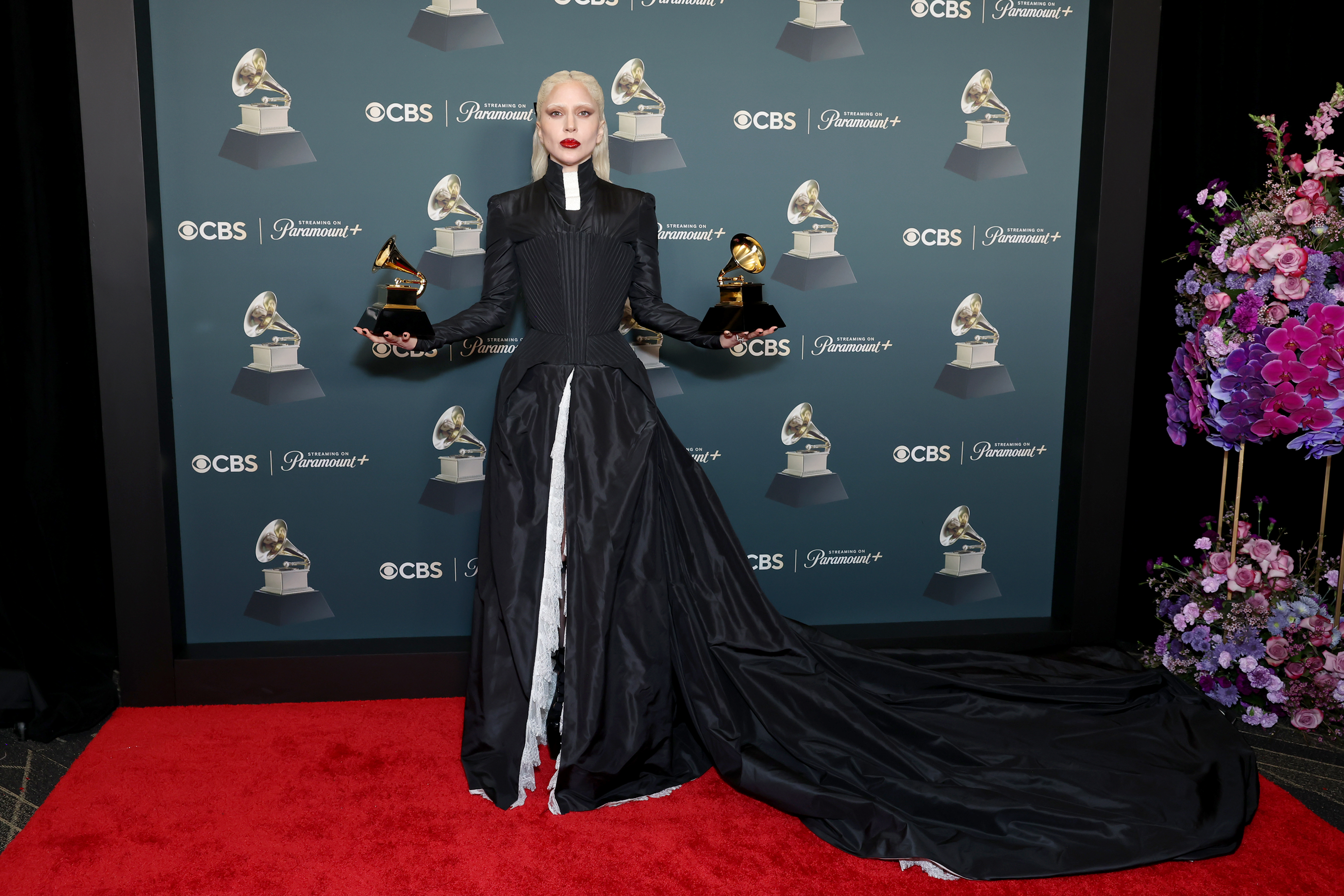
Lady Gaga arrived in an elaborate feathered black swan creation by cult French brand Matières Fécales—yes, that does translate to “Fecal Matter,” and no, we’re not making this up—looking like she’d just descended from some gothic celestial realm. She later commanded the stage in what can only be described as a caged bird ensemble, delivering “Abracadabra” with the theatrical intensity that reminds everyone why she remains pop’s reigning queen of spectacle.
Teyana Taylor wore custom TOM FORD by Haider Ackermann—an asymmetric, backless evening dress dripping in bronze crystals that moved like liquid light across her body. Doechii’s Roberto Cavalli featured a thirteen-foot train that required its own choreography team. Bad Bunny showed up in Schiaparelli’s first major foray into men’s suiting: a tuxedo with corset detailing that somehow managed to be both avant-garde and perfectly classic.
Billie Eilish’s Hodakova look deconstructed menswear tailoring with suit pants transformed into a jacket and skirt combination that broke every rule in the most elegant way possible. And then there was Chappell Roan, who removed her cape mid-evening to reveal a Mugler négligée gown held strategically in place with nipple clamps, because apparently 2026 decided subtle was the enemy of art.
BREAKTHROUGH VICTORIES AND HISTORIC FIRSTS
British soul-pop vocalist Olivia Dean took home Best New Artist, lighting up the stage with her chart-breaking hit “Man I Need” in a performance that felt both intimate and triumphant. Billie Eilish and Finneas won Song of the Year for the emotionally devastating “Wildflower,” making them the most-awarded artists in that category in Grammy history with three wins each. Lady Gaga claimed Best Pop Solo Performance for “Mayhem,” because of course she did.
Tyler, The Creator’s “Chromakopia” snagged the inaugural Best Album Cover award. Steven Spielberg won Best Music Film for producing “Music by John Williams,” inching him closer to EGOT status—he now needs only an Emmy to join that exclusive twenty-one-person club. And in a groundbreaking moment for K-pop, “Golden” from Netflix’s animated blockbuster “KPop Demon Hunters” won Best Song Written For Visual Media, giving the genre its first-ever Grammy win.
PERFORMANCES THAT STOPPED TIME

Bruno Mars and Rosé opened the show with their global smash “APT,” setting the tone for a night of performances that ranged from joyfully unhinged to devastatingly beautiful. Sabrina Carpenter, dressed as a flight attendant, performed “Manchild” atop a massive airplane on stage because why wouldn’t you? Tyler, The Creator crafted a multi-layered performance that was equal parts enthralling and eerie, opening with “Thought I Was Dead” and closing with “SUGAR ON MY TONGUE.”

But the night’s most emotionally resonant moment came during the In Memoriam segment. After a supple tribute to D’Angelo, Lauryn Hill stepped to the mic for a rare performance honoring soul legend Roberta Flack, who died in February 2025. Hill delivered an abbreviated but utterly devastating version of “The First Time Ever I Saw Your Face,” accompanied by Jon Batiste on keys. Leon Bridges, October London, Lalah Hathaway, John Legend, and Chaka Khan joined for a medley of Flack hits before the climax: Wyclef Jean emerging from the audience with a guitar for a spine-tingling rendition of “Killing Me Softly With His Song”—first as Flack recorded it in 1973, then as the Fugees reimagined it in 1996.







Leave a Reply